November 27, 2026 - Custom Software Development
Digital ChordsHow to Choose the Right Custom Software Development Company
Engaging a software development company is a business decision and needs to be researched as diligently as any other vendor decision. The right development partner can build software that helps you enhance your operations and provide better service to your customers. On the other hand, the wrong partner can build unworkable code that does not meet your business needs and blows your budget in the process.
This guide will show you how to determine the right development partner for you, and provide a checklist of the things you should analyze before engaging a development company.
1. When Does Custom Software Make Sense, and When Should I Buy Off-the-Shelf?
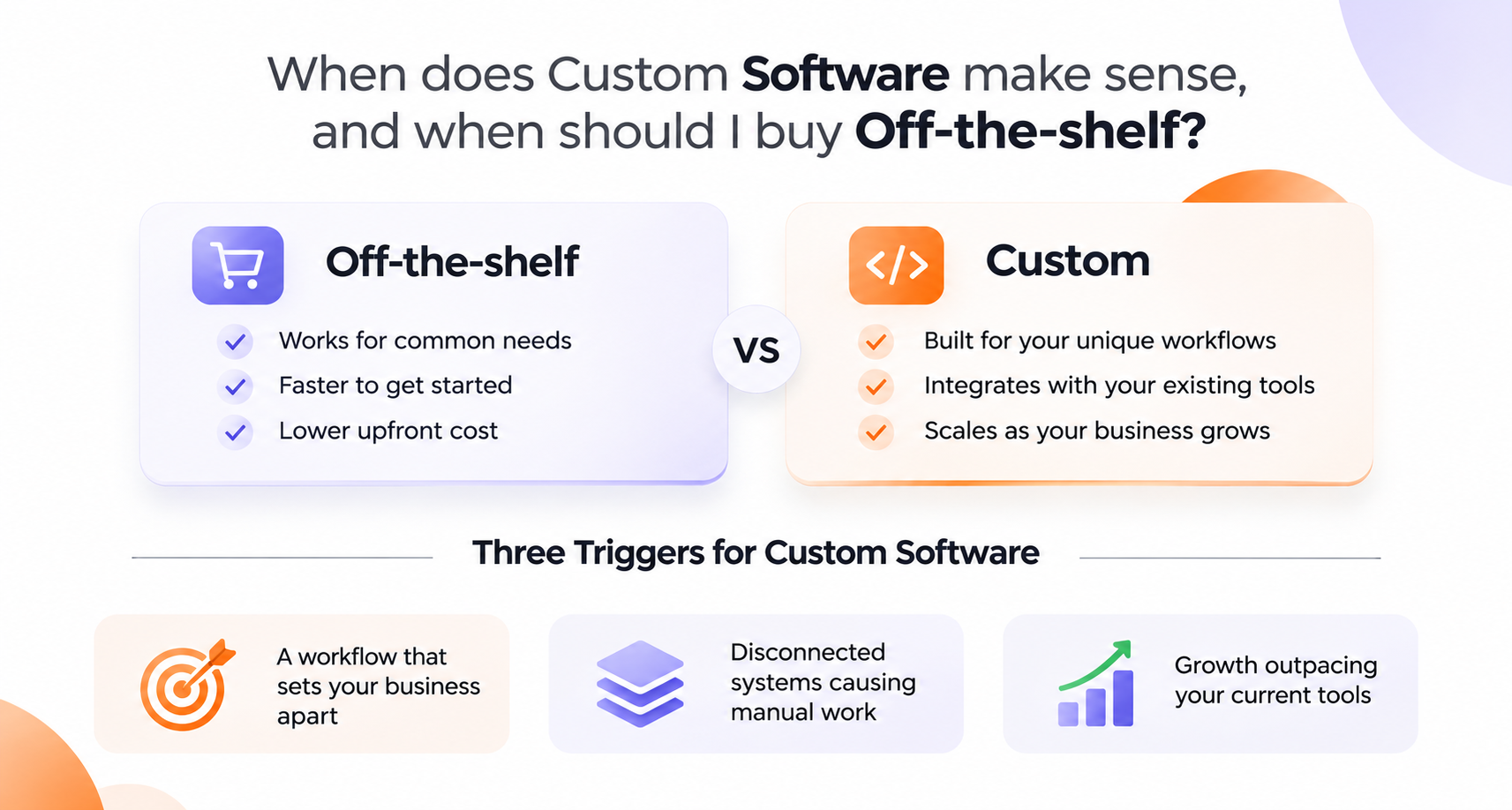
In general, you should go the custom development route if you have workflows that cannot be accommodated by out-of-the-box software, and integrations that cannot be achieved with off-the-shelf solutions. However, you should buy off-the-shelf if your needs can be satisfied with an existing solution.
You should look for custom software development if:
You have a unique process that helps your business differentiate: Perhaps your business process is so unique that the off-the-shelf software cannot integrate it.
Your business relies on manual data entry and other work arounds: Your employees do a lot of manual data entry because your business systems are not integrated.
Your business is outgrowing your current software: Your operations and transaction volumes have increased, but your current software cannot manage it.
Custom Software vs Off-the-Shelf Software
Business Requirement | Off-the-Shelf Software | Custom Software |
Standard Business Operations | Usually Suitable | May be unnecessary |
Unique Workflows | Limited Flexibility | Designed around your workflows |
Third Party Integrations | Limited | Designed to integrate with your preferred systems |
Scalability | Vendor Dependent | Designed to scale with your requirements |
Time to Market | Often Shorter | Depends on Your Requirements |
Ownership and Control | Vendor Terms | Varies |
Is custom software development worth it?
Yes, if an expensive, large, complex business requirement cannot be met with Off-The-Shelf Software.
Is custom software development still worth it with AI tools?
Yes, there are elements of software development (system architecture, integration & security, and software testing) that require engineering judgment that cannot be performed by AI.
Not all technology investments must improve core business processes to be valuable. Sometimes software is built just because it can, and that is okay, as long as costs are controlled.
2. Should I Build In-House or Hire a Software Development Company?
A software development company can often be quicker when experience and expertise are the main constraints. An in-house team can be the better choice when software development is a core, permanent business function.
A core, in-house software development team requires heavy, ongoing investment (People, Process, Technology and Tools). Finding specialists in different domains can also take time.
They leverage an established engagement model to access a variety of skills.
Factor | In-House Development | External Development Partner |
Recruitment | Your responsibility | Team supplied by partner |
Technical management | Internal leadership required | Partner manages delivery responsibilities |
Skill availability | Depends on existing employees | Access to different technical specialists |
Project ramp-up | Recruitment and onboarding required | Depends on discovery and team availability |
Long-term control | Direct internal control | Defined through contract and collaboration |
Ongoing costs | Salaries and operating expenses | Agreed project or engagement fees |
An external partner is of particular value to rapidly launch a new product or service, update or replace an existing one, or integrate multiple business systems without the need to fully establish an engineering department.
Digital Chords is a local digital strategy, design, and software development company that boasts over 120 projects in four years in business as evidence of its experience. This provides a basis for evaluation on how it works across a range of business needs.
3. How Do I Choose a Custom Software Development Company?
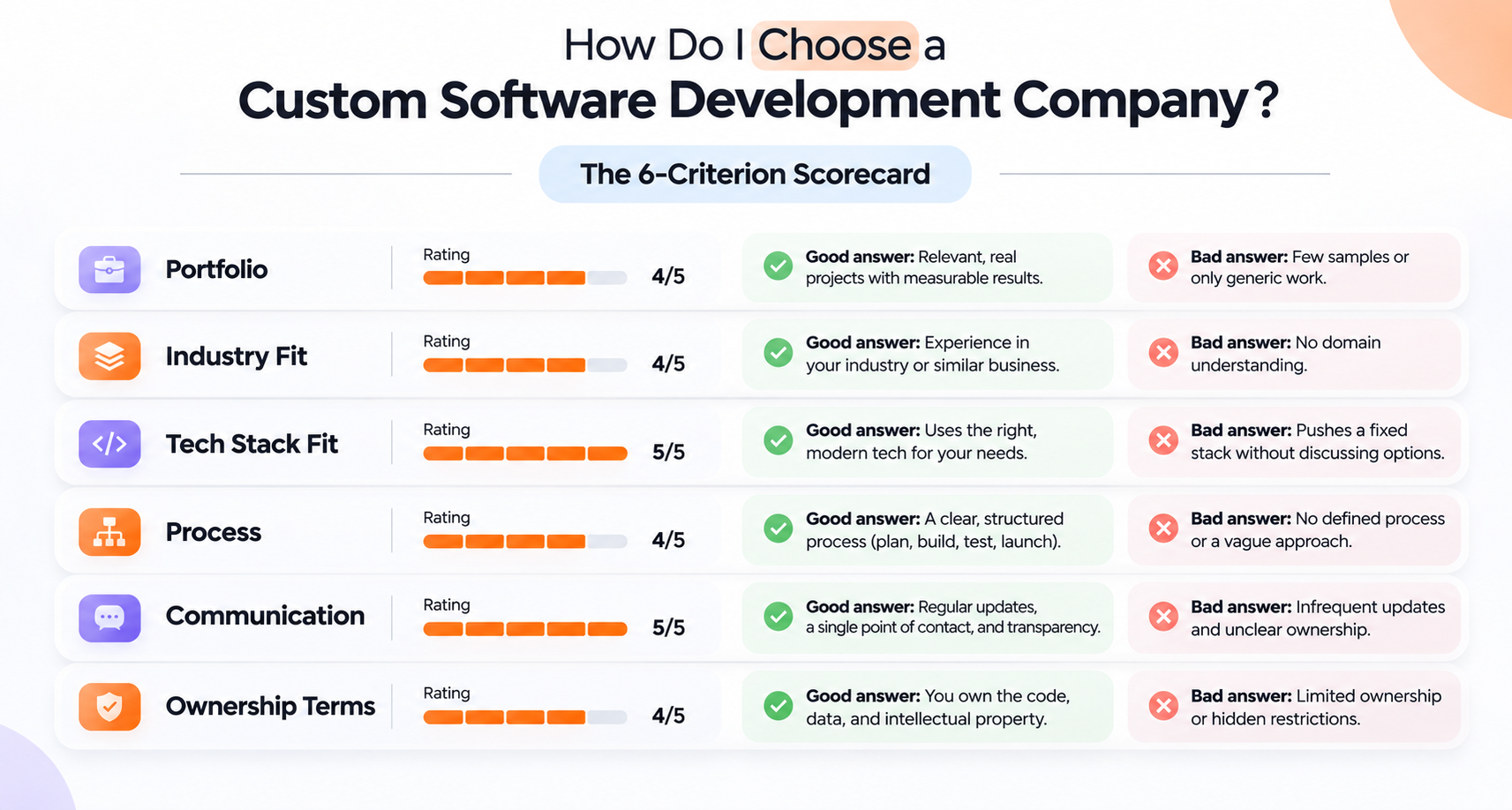
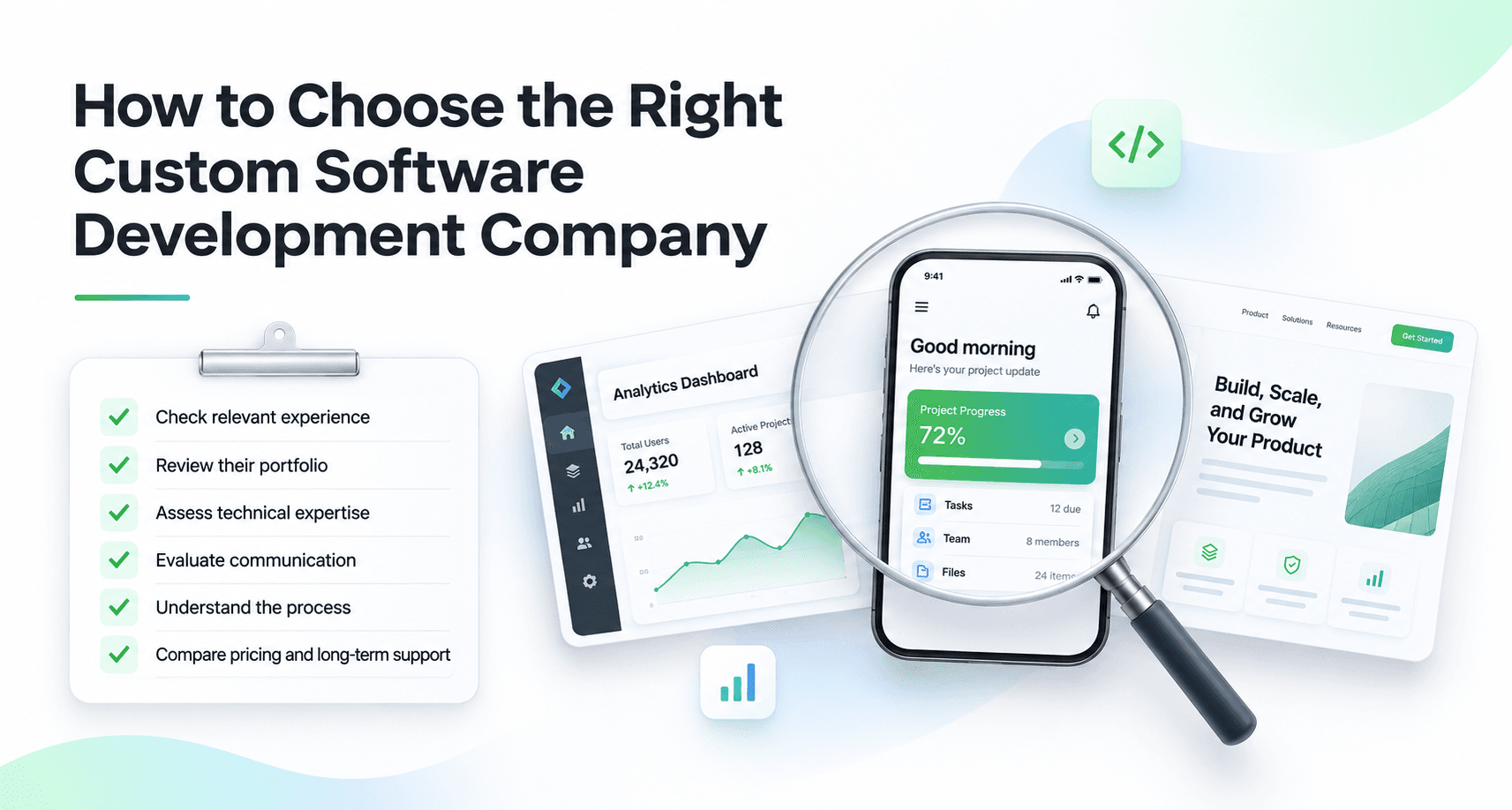
To choose the right company, evaluate six key criteria. These are the development company’s relevant portfolio, industry and business knowledge, technology and development expertise, processes and procedures, and communication and ownership terms.
Do not base your choice on an impressive website or proposal alone. Insist that each company explain how its experience is relevant to your business needs.
A Six-Criterion Software Development Company Scorecard
Use this weighted scorecard to compare potential development partners.
Evaluation Criterion | Weight | What a Good Answer Looks Like |
Portfolio and Case Studies | 20% | Shared various projects and their outcomes |
Industry Knowledge | 15% | Understood the customers, the challenges, and the process flow |
Tech Stack and Expertise | 20% | Justified the use of various tech for the project |
Development Process | 20% | Explained the different stages of development (discovery, delivery, testing, and launch) |
Communication and Collaboration | 15% | Posted mechanisms of communication and processes |
Code ownership, IP, and handover | 10% | Explained ownership of IP and handover of code |
Each of the above criteria should be scored from 1 to 5, and the score multiplied by the weight to get the final score.
What Should You Check in a Portfolio?
Beyond a pretty UI, a development portfolio should outline projects that speak to a firm's ability to tackle business challenges.
Look for:
Challenging integrations and data migrations
How they resolved a tight time window or other restriction
Client referrals and measurable outcomes
Digital Chords has case studies for projects with ClaraRx, HCA, OKLA, Metro Online, Dental Aesthetics and ZPC. Looking over the case studies gives you an idea of the breadth of challenges they have taken on.
Evaluate the Tech Stack
A good development company should be able to explain their recommended tech stack for your project. This includes programming languages, frameworks, databases, cloud services, APIs, and third-party integrations. They should also explain licensing constraints.
Just because a piece of technology is new, doesn’t mean it is the best. Technology should be reliable, maintainable, secure, and adequate for the expected workload.
4. What Questions Should I Ask a Software Development Company Before Hiring?
You want to look for information about how the company plans, builds, and supports your software. The answers should give you information about responsibilities, delivery, and potential pitfalls.
Here are 15 questions to help guide your decision.
Discovery and Planning
How do you get to know our business requirements before writing a single line of code?
Do you perform a paid discovery process?
How do you define and prioritize features?
How do you analyze and address potential technical and integration risks?
Delivery and Development
What development methodologies do you use?
How often will we see working software?
How will you manage changes to the requirements?
What is your process for testing the software?
Team and Communication
Who will be working on our project?
Will we have a dedicated project or delivery lead?
How often will we get status updates?
How will you manage communication during a lull in project work?
Post-Launch and Support
What kind of support and maintenance do you provide after the software is delivered?
How will you address software bugs and security patches?
What will we get (source code, documents, and/or other) when the project is complete?
A good custom software development company should be able to answer these questions. Be wary of companies where answers to these questions are unclear, responsibilities are vague, or critical information is pushed to after you sign the contract.
5. What Are the Red Flags When Hiring a Software Development Company?
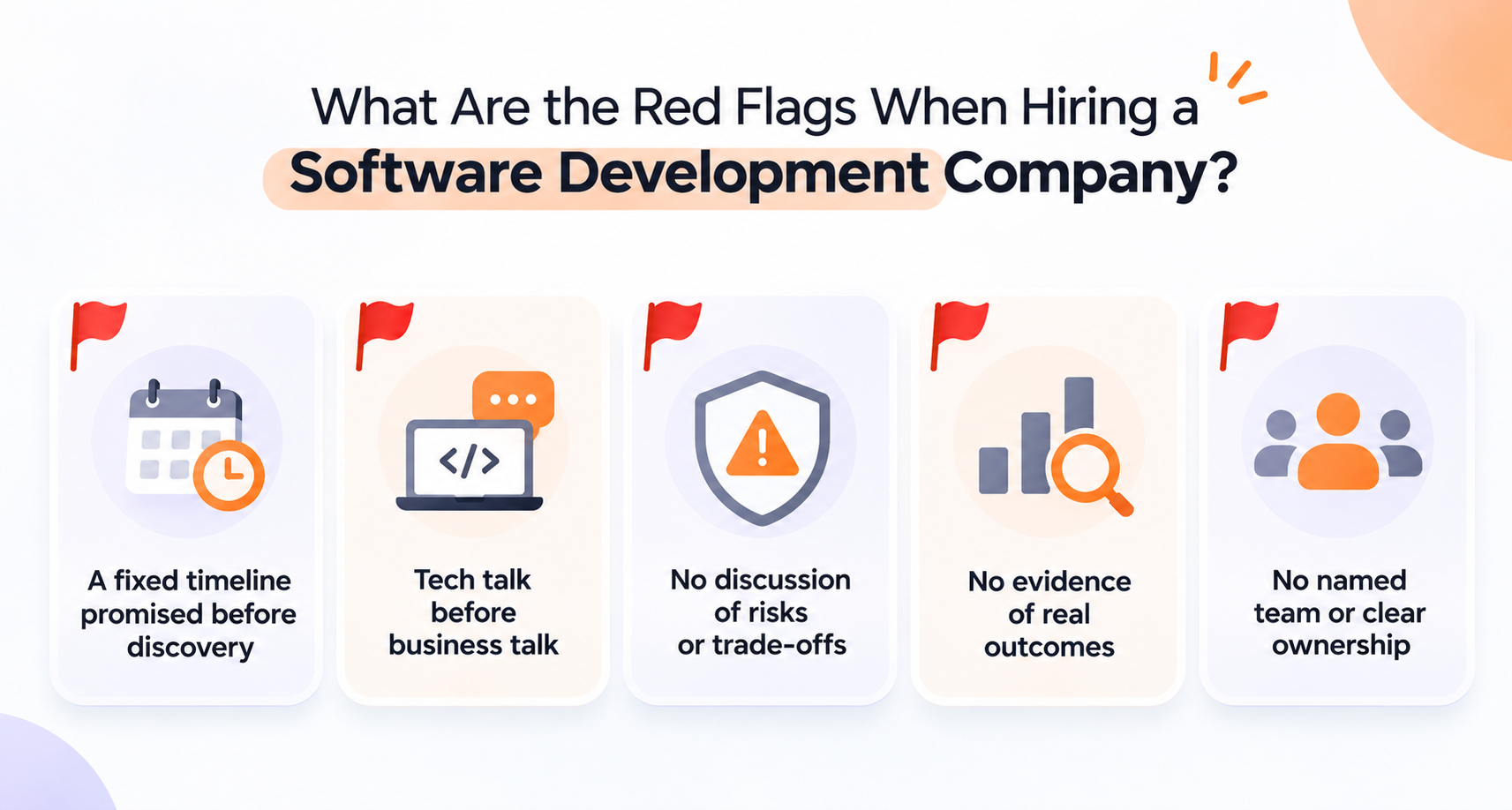
The biggest warning signs are unrealistic delivery promises, unclear communication, and a lack of evidence in a portfolio. Other warning signs include contracts that do not outline ownership and/or responsibility.
Watch out for these red flags:
Timelines promised before discovery: A company should understand the details of your requirements before committing to a timeline and delivery.
Technical discussions before business discussions: Developers should first understand the problem to offer recommendations for the most appropriate solution.
Lack of discussions surrounding risks: All software projects have potential problems that may be operational, integrational, or technical in nature.
No evidence of outcomes: A portfolio filled with screenshots does not represent the outcomes of the projects. It makes it difficult to evaluate.
No identified project team: You should have the opportunity to meet the people that will be managing and developing your software.
Lack of clarification for ownership of IP: Agreements that leave ownership of the IP or the source code unclear should be avoided.
Poor communication: Raising concerns about communication during the sales process should disqualify a company. Communication is key to a successful outcome.
Should I Choose the Cheapest Software Development Company?
No. Consider the total cost of ownership. The price may be low due to a lack of full-feature completion or support for the product after it has been delivered. Consider the total scope and deliverables as well as the responsibilities outlined in the contracts before making your decision.
What Are the Disadvantages of Developing Custom Software?
Custom software comes with a set of trade-offs that a business should be aware of:
Higher upfront commitment than with many off-the-shelf solutions
Longer implementation time than with many off-the-shelf solutions (due to the design and build process)
Ongoing responsibility for the software (maintenance, updates, etc.)
Greater reliance on adequate documentation
More complexity when integrating other systems and migrating data
If the responsibilities outweigh the expected business benefits, using an existing software product may be a better alternative.

Ready to Build Your Custom Software
Get expert guidance, a clear plan, and a development partner that fits your goals from idea to production ready product.
6. How Much Does Custom Software Development Cost and What Drives the Price?
Different factors impact the price of a custom software development project, including the scope and complexity of the project, the number of required features, integrations, and how the team is structured. Each project is unique and therefore has a custom price.
Better understanding of the cost drivers helps clients more accurately compare proposals.
Cost Drivers | Influencing Factors | Questions |
Scope | Features, user roles and workflows | What is included in the agreed scope? |
Integrations | APIs and external integrations | Will integrations be built by the team? |
Compliance | Security and privacy | What obligations and requirements apply? |
Team model | Specialization and duration | Who will be on the team? |
Data | Volume and quality | How will data be migrated? |
Maintenance and support | Bugs and updates | What is included after launch? |
When assessing proposals, be sure to evaluate what is included in each scope. This includes design, development, testing, deployment, and post-launch support.
Additionally, understand if third-party services and licenses are included. Expenses incurred from cloud hosting, software subscriptions, and external APIs may not be included.
We can review your technical requirements and help clarify your functional requirements to assist in defining a project scope before committing to a development project.
7. Fixed Price vs Time and Materials: Which Pricing Model Should I Choose?
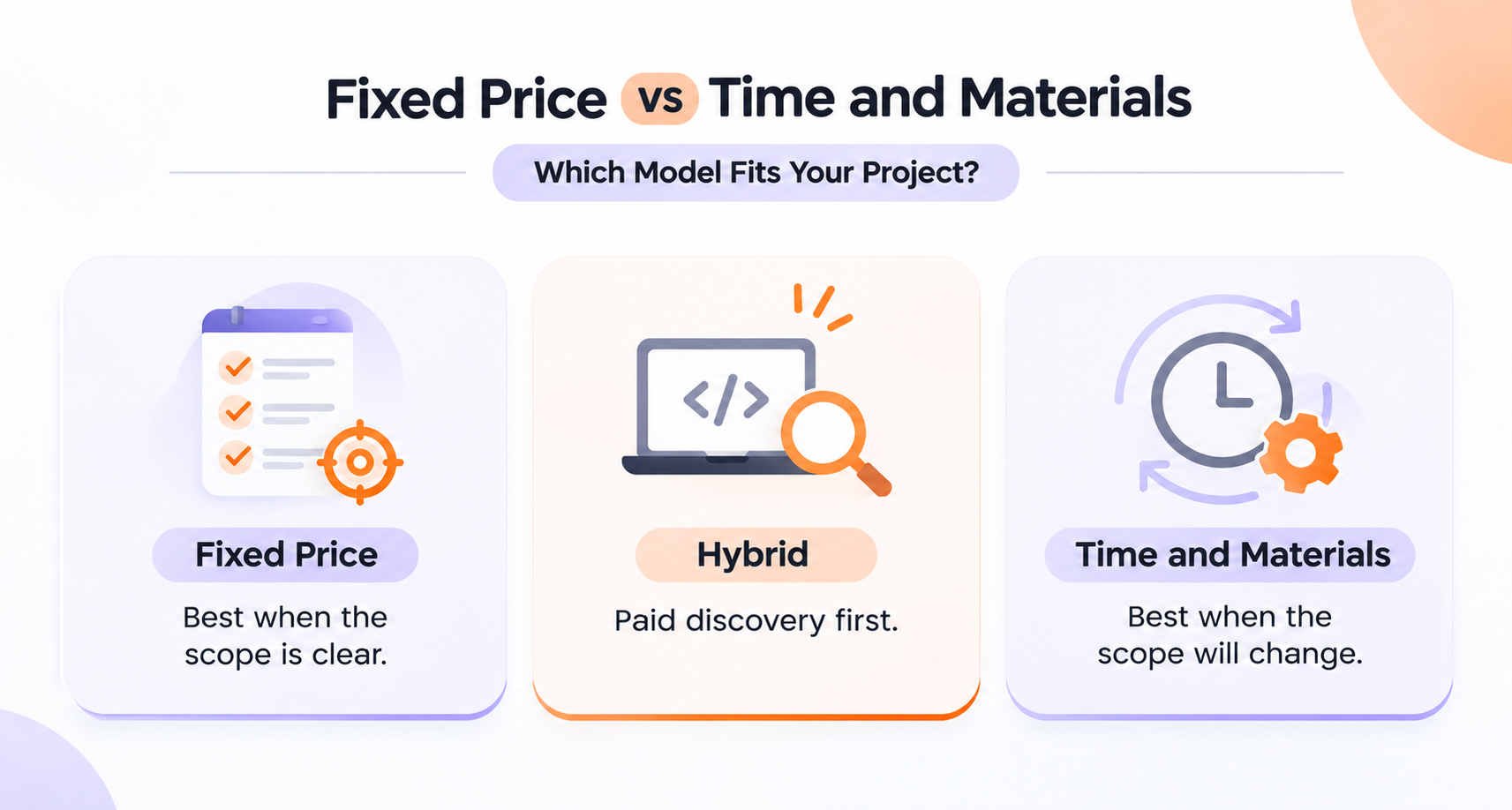
Choose a fixed price model if the scope and requirements of the project are well defined. Select time and materials if the scope is expected to change.
Fixed-Price Development
A fixed-price arrangement specifies the scope of work, deliverables, timeline, and price upfront.
It is useful when:
Requirements are documented
Deliverables are defined
Changes are expected to be limited
The organization requires a fixed project cost
Time and Materials
In a time and materials arrangement, you pay for the development effort based on pre-agreed rates and reporting.
It is useful when:
Changes to requirements are expected during development
A product is being developed based on customer feedback and may evolve
Flexibility is required to change the order of implementation of product features
The product being developed requires ongoing evaluation of alternatives
A Hybrid Approach: Paid Discovery
A practical approach is to perform a paid discovery and then agree on a delivery model.
Discovery defines the requirements of the product being developed, the technical options available to integrate the product with other systems, the level of risk involved, and the effort required. Once requirements are scoped, the pricing can be agreed upon.
This reduces the risk of agreeing to an unrealistic scope before the technical details are defined.
8. How Long Does a Custom Software Project Take?
The time required for a custom software project depends on a number of factors, including the project scope and complexity, level of integrations and the decision-making process. A reasonable timeline should be provided after the initial discovery rather than promising a date prematurely.
A typical software project consists of five phases:
Phase | Main Activities | What Determines Duration |
Discovery and Planning | Requirements analysis, feasibility and scope definition | Business and stakeholder complexity |
UI/UX Design | Wireframing, user journeys, prototyping | Number of screens and feedback cycles |
Development | Front end, back end, API and integrations | Features and complexity |
Testing and QA | Functional and non-functional testing | System complexity and defects |
Deployment | Launch and handover | Infrastructure and readiness |
The project team may include a project manager, business analyst, UI/UX designer, front-end and back-end developers and QA engineer. Team composition may vary for a project.
Estimates for timelines should be discussed with the Digital Chords delivery team for verification and adjustment prior to any commercial publication. There are several factors that impact delivery, including changing requirements, external dependencies (APIs, integrations, data migrations, etc.), and stakeholder approvals.
How Do I Measure Whether Custom Software Was Worth It?
Custom software is worthwhile when there is clear, measurable improvement toward business goals that were established prior to development.
Before you sign, outline what you expect to achieve and establish a baseline for comparison. Some useful performance indicators are:
Time saved: How much employee time is saved via automation?
Error reduction: Are data entry errors occurring less or disappearing?
User adoption: Are employees and customers using the application?
Operational efficiency: Are workflows faster, easier to manage?
Improved customer experience: Are responsiveness and service quality improving?
Improved ROI: Are measurable business benefits occurring that justify the cost to develop and maintain the application?
Custom application integration can automate repetitive work. For example, if your team spends several hours each week transferring information between disconnected systems, a custom application integration may be appropriate.
Prior to launch, set measurable success criteria with your development partner. This makes it easier to determine if the work delivers what the business expected.
What Should the Custom Software Development Process Look Like?
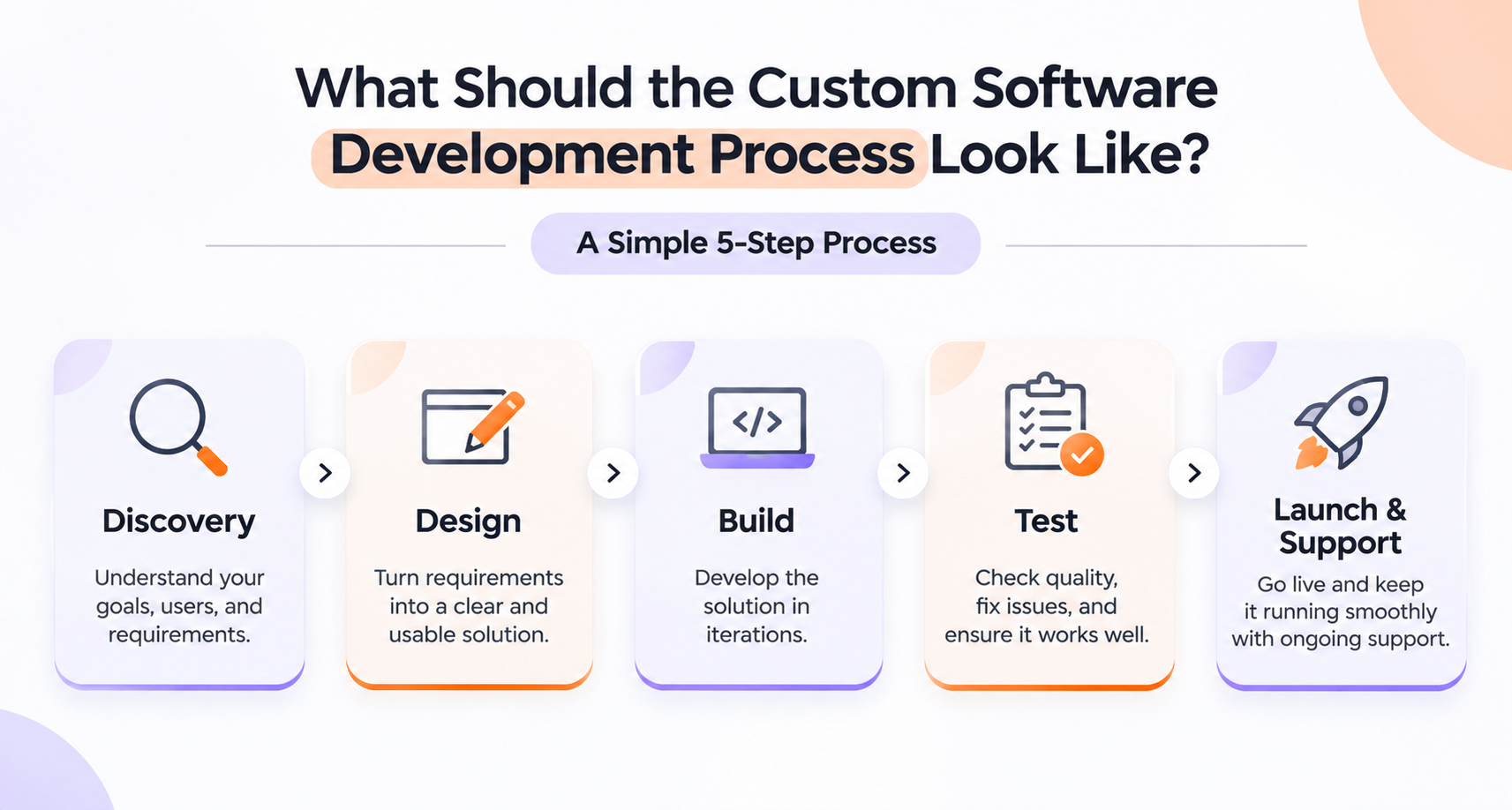
The development process should include moving from business discovery to design, development, testing, and deployment.
Here is what to expect:
Discovery: Learn about the business, its goals, users, workflows and available technologies.
Planning and design: Decide on the system architecture, functionality and features, user journeys and interactions.
Development: Write code to implement the designed features, interfaces, integrations and back-end systems.
Testing: Assess functionality, usability, performance and security of the application.
Deployment: Launch the application and provide transition and support documentation.
Each phase should include clear and defined deliverables and opportunities for feedback.
Digital Chords takes a design-focused approach to software and system development that incorporates the objectives and goals of the business. Its team is able to explain how the proposed workflow will be modified to meet your business needs.
Choose Digital Chords for Your Custom Software Development Project
Selecting a development partner isn't just about picking a company with software coding expertise; it's also about finding one that knows the ins and outs of your business.
Digital Chords is a digital and design firm that has worked on more than 120 projects in four years or more. It has previously worked on ClaraRx, HCA, OKLA, Metro Online, Dental Aesthetics and ZPC.
If you require a business application, a front-facing platform, a complex integration, or a solution that will eliminate disjointed systems, having a clear understanding of your needs is the beginning.
Business-focused software planning
Design and development skills
Experience with various project needs
Emphasis on usability and user experience
A shared understanding of the purpose of the project
Looking for suggestions on software needs? For more information on how we can help you turn your business needs into a viable software solution, you can explore our custom software development services.
Ready to Build Your Custom Software
Get expert guidance, a clear plan, and a development partner that fits your goals from idea to production ready product.
Frequently Asked Questions
Look for information about its portfolio, relevant industry experience, technical capabilities, development process, and communication. Check its terms regarding ownership of source code. Compare companies using weighted scorecards and require them to provide evidence regarding the projects you are evaluating.
Yes, as long as off-the-shelf solutions don’t create inefficiencies or inhibit the business processes critical to running the operation. Small businesses need to weigh the benefits against the burden of responsibility for development and maintenance.
Comparing 3-5 companies gives a good sense of the various project scope and engagement models.
No, software developers won’t be completely replaced by AI. Certain aspects of software development will be replaced by AI, but developers will be vital for architectural decisions, security, integration and other aspects of complex problem-solving, as well as maintaining the software.
Yes, you should own the code if the development agreement assigns the relevant intellectual property rights to you. Check repository access, source code delivery, documentation, and third-party license terms before signing the development agreement.
Prepare a description of your business problem, who will use the software, key features of the software, the systems that the software will interact with, the outcome that the software is intended to achieve, and any integration requirements. While a full description of your technical requirements is not necessary, having this information before the first meeting with the development company will help expedite the process.
Factors to consider should include the developer’s skill level and experience, communication, time zone difference, project management and partner’s ability to assist you in achieving your business goals.
Flexibility can be achieved through delivery of the software using an agile methodology and/or payment using a time and materials basis. Change requests will need to be assessed, approved and then scheduled in the development of the software.